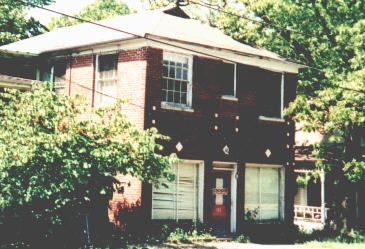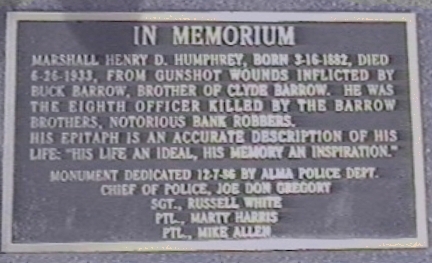
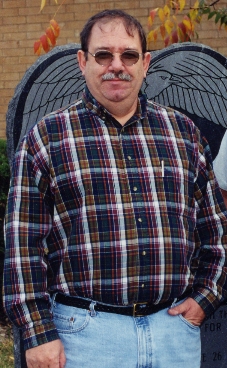
James R. Knight grew up in Alma, Arkansas and now lives in Germantown, Tennessee. He is the author of an article entitled, "Incident at Alma" which appeared in "The Arkansas Historical Quarterly". The article is an attempt to give a complete, accurate account of the Barrow gang's operations in Crawford, Washington, and Sebastian Counties in the summer of 1933 and is based on all available local newspaper stories, as well as other published works, and personal interviews. In this section, I am including some photos and excerpts from his booklet. I would like to thank Mr. Knight for providing me with a copy of his booklet, and granting me permission to reproduce materials from it. The material presented here, is the copyrighted works of James R. Knight and may not be used without the express permission of the author or the Arkansas Historical Quarterly. |
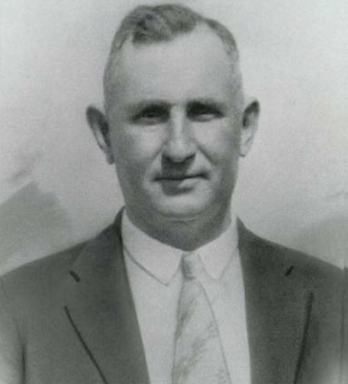
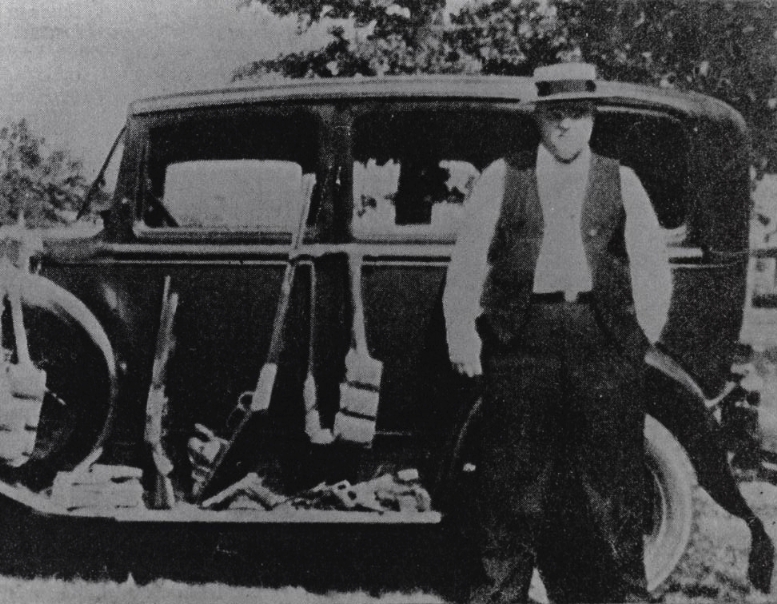
Marshal Henry D. Humphrey of Alma
Author's collection, courtesy of Humphrey family
In the summer of 1933, Bonnie and Clyde were the most wanted criminals in the Southwest. Even though they passed through northwest Arkansas many times during the two years they were active, that summer was the only time they actually operated in the area. They stayed about ten days and were involved in or accused of robbery, murder, rape, and assult and were the subject of a three-county manhunt. |
Henry D. Humphrey was a well-liked honest fellow who did repairs and odd jobs at the local high school and farmed with a team of mules. He was fifty-one when he became a lawman. He had been urged to run for town marshal of Alma by some local businessmen and was elected to a term beginning on May 1, 1933. He kept his day job because the town marshal in a town of eight hundred was primarily a night watchman and because the job paid only fifteen dollars a month. Just before two o'clock on Thursday morning, June 22, two men captured Marshal Humphrey while he was making his rounds in downtown Alma. They took his pistol and flashlight and bound him with baling wire.They then broke into the Commercial Bank building by way of a back window, laid the marshal on the floor, and went to work on the four-thousand pound safe containing thirty-six hundred dollars. At the time of the robbery, no one knew the Barrows were in the area. When their presence became known three days later, some townspeople speculated that the gang might have robbed the bank. Walter Patton Jr, a long-time Alma resident and Marshal Humphrey's nephew, says that the safe was eventually recovered from Hollis Lake southwest of Van Buren. His father, who worked for the bank, was called in to open it. All the money was still inside, and the safe was put back in service. To this day no one knows who robbed the bank that Thursday morning. Before the day was over, however, the town of Alma had ordered for Marshal Humphrey, a steel bulletproof vest. It was to be delivered in about a week and would protect against pistol rounds and shotgun pellets. It would come too late. Buck Barrow and W.D. Jones left the Dennis Tourist Camp in the Ford sedan sometime before noon on Friday, June 23. There were two reasons for the trip. First, they were almost broke. Bonnie's care, medicine, and their room and board for the last nine days had taken almost all their cash. |
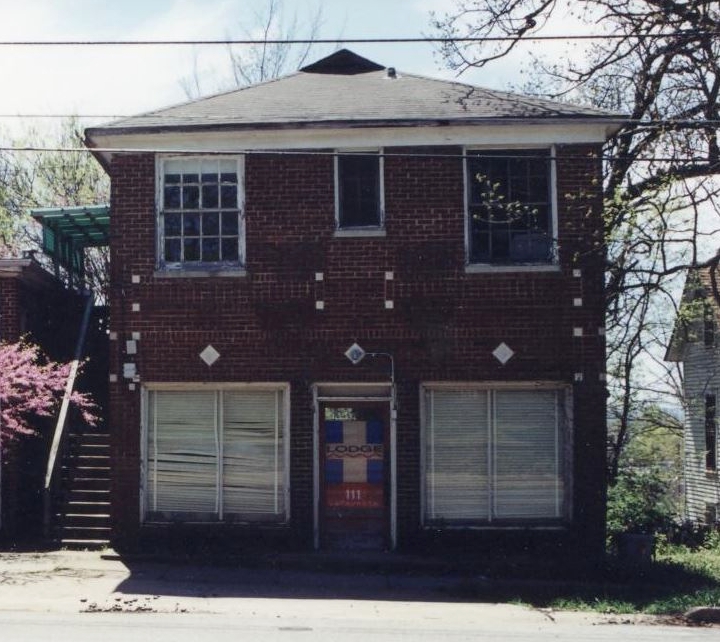
Bonnie's burns (from the Wellington car wreck) were far from healed, and Clyde did not like to leave her, so the job of raising some money fell to Buck and W.D. About 5:30 P.M. Buck let W.D. off in front of their chosen target, the Brown Grocery at 111 West Lafayette, and drove around the block to the Mt. Nord area to wait. Jones netted twenty dollars from the register, and thirty-five cents from the bag boy. He stole the delivery truck, which he had to start by pushing it down the hill, and drove around the block to meet Buck. They were last seen in the Ford sedan driving south on U.S. 71 at a high rate of speed. The Fayetteville police placed calls to surrounding communities, including Alma, since it was at the intersection of U.S. 71 and U.S. 64. If the bandits stayed on U.S. 71, they would pass through the town. The call to town reached Marshal Humphrey at the AHC service station run by his son Vernon. He was given the license number and asked to look for the getaway car last seen headed his way. Vernon Humphrey would have gone with his father, but he could not leave the station unattended. Ansel M "Red" Salyers offered to drive Marshal Humphrey in his maroon Ford four-door. Red worked for the electric company but was also a Crawford County deputy sheriff. The Marshal was carrying a Smith & Wesson .38 revolver which belonged to his brother-in-law, Walter Patton. He had borrowed the pistol because the bank robbers had taken his city of Alma weapon. Saylors carried a Winchester 30-30 he had taken in trade for a man's electric bill. It was about 6:20 P.M. when the two men left the AHC in Salyer's car. Buck Barrow had driven the dangerous curves of U.S. 71 between Fayetteville and Alma in about fifty-five minutes. At 6:25 P.M. he passed Salyer's car. He would have had a clear road back to the Dennis Motel had it not been for the slower-moving blue Chevy that had just disappeared over the crest of the hill ahead. By the time Buck saw the car, it was too late. Driving with all the windows down on that 102-degree day, Salyers and Humphrey easily heard the crash when Buck rear-ended Wilson's car. As soon as they could, they turned around and rushed back to the scene. As they approached, Marshal Humphrey saw the license plate (1933 Indiana 225-646) and told Salyers that it was the one they were after. Wilson had just managed to crawl out of his wrecked car when the officers' car drove up and turned to block the road. Buck picked up Clyde's sawed-off shotgun, and W.D. took a BAR (Browning Automatic Rifle), a .30 caliber machine gun-Clyde's automatic weapon of choice. When Wilson saw the two armed men, he wisely ran away into the cane field next to the road. Whether Marshal Humphrey shouted a challenge is not certain, but as soon as he appeared out the right-handed door, Buck shot him full in the chest with buckshot, blowing him into a ditch by the side of the road. Salyers, who was somewhat shielded by the car, was left with his Winchester to face the pair alone. After a few seconds, there was a break in the bandits' fire. Buck's shotgun had jammed or was empty, and he was in the process of throwing it back in the car and getting his own Winchester Model 1912 16-gauge pump. Knowing they would kill him if he stayed, Salyers ran toward a house over one hundred yards to the west. W.D. could not hit the running man, but managed to put bullets into and through the house itself, into the barn beyond the house, and even into a strawberry field several hundred yards away, where Walter Collum was working. Salyers reached the safety of the house's rock chimney and began to reload his rifle's 7-round magazine. Meanwhile, Buck and W.D. ran for the lawman's car, since it was the only one that would still run. One of the gunmen went to the wounded marshal and took his pistol, while the other got in and started the car. Salyers resumed shooting from the house. In spite of hits from the deputy's rifle, W.D. and Buck drove back north up U.S. 71, firing at a passing motorist, B.C. Ames of Fort Smith, on the way. By Monday morning, the 26th, the press had the story. The morning "Southwest American" ran the headline, "The Barrow Boys Shot Marshal". By the afternoon deadline, the "Fort Smith Times Record", had pictures of Buck, Clyde, and Bonnie. They also had another scoop. Now it was murder. Marshal Henry D. Humphrey died at 10:15 that morning. |
Publication source
Arkansas Historical Quarterly
Vol.LVI Winter 1997 No.4
On June 22nd 1933, two bandits, believed to have been Buck Barrow and W.D. Jones, kidnapped Alma Marshal Henry D. Humphrey and forced him to enter the Commercial Bank with them. After tying him to a pillar, they loaded the bank's safe into a truck, and vanished out of sight. Bonnie Parker was still suffering from the burns she received in the Wellington crash. The Barrow gang's funds were running low and Clyde was too concerned with Bonnie's welfare to leave her. So Buck Barrow and W.D. Jones began robbing the area grocery stores alone. On June 23rd Buck and W.D. robbed Robert and Nell Brown's Grocery store in Fayetteville and headed toward Alma. |
Humphrey had heard the radio broadcasts about the two bandits heading his way and believed that these were the same two men that had embarrassed him on the previous day. He headed out with his deputy, A.M. Salyer to intercept them on the road to town. While enroute, they saw a car traveling at considerable speed, pass them and crash into another vehicle. The victims of the other car were angry at the two men for causing the crash and picked up a couple of rocks and approached the bandit's car. When they found themselves looking down the barrel of Buck's shotgun, they dropped the rocks and ran away. Humphrey and Salyer who had both witnessed the accident went to assist the victims, not knowing that the victims were in fact the objects of their search. Buck and W.D. used the car's doors as a shield and began firing away at the two lawmen. W.D. using a .41 caliber pistol, missed his target but Humphrey took Buck's shotgun blast to his chest. The deputy ran away and took refuge at a nearby farm house. Marshall Humphrey died on Monday June 26, 1933. |
Hideout Update: Article in the March 14, 1999 Arkansas Democrat Gazette about Bonnie and Clyde. On June 24, 1933 Clyde robbed Brown's Grocery Store of $20. That store building is now owned by the Central United Methodist Church located at 111 W. Lafayette Street, Fayetteville, AR who is planning to demolish it for a parking lot. Many want the building restored. Note: The woman who had treated Bonnie after the accident had claimed that Bonnie's burns were caused by battery acid which had spilled onto Bonnie while she was pinned under the car. Bonnie's immediate treatment of bicarbonate of soda would have been a good thing, as this would have neutralized the effect of the acid. |